
Home / Costs
Order money, written down as each charge lands
An order is paid in at least two parts, weeks apart, and converted from yuan by someone other than the seller. Writing each part down when it happens is the only way to know what an item really cost.
The yuan figure a card leads with
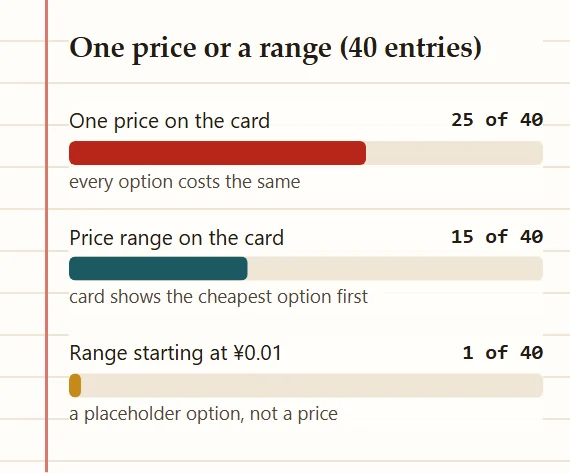
Catalogue prices are in yuan, copied from the seller. In our check of forty entries on 20 October 2026, twenty-five showed one price and fifteen showed a range. A range means the options are priced differently, and the card leads with the cheapest.
The cheapest option is not always a real one. One jewellery entry’s range began at ¥0.01, and the rough dollar figure beside it read $0.00. That kind of option exists to hold a place in a menu, not to be bought. Always open the option you want and copy its own price into your first line.
The dollar figure on every entry is a rough conversion for orientation. It is not what CNFans will charge and not what your bank will take.
Whose exchange rate actually lands on you
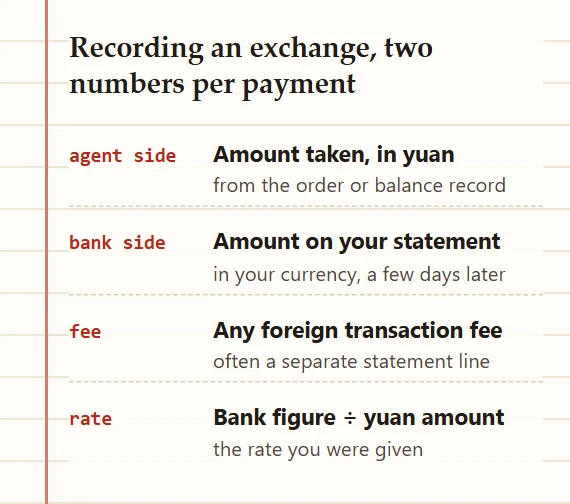
Two exchange rates can touch an order. An agent that keeps your balance in yuan or dollars converts a top-up at a rate it chooses; the archived CNFans top bar offered a currency switch set to US dollars. When your card is charged in a currency other than your account’s, your bank or card scheme converts it at a rate it sets, sometimes with a fee on top.
Neither rate is the mid-market figure you see in a search result. The way to know what you paid is to write both numbers down: the amount in yuan the agent took, and the amount your bank statement shows a few days later. Divide one by the other and you have the rate you were actually given.
Service fee and other agent charges
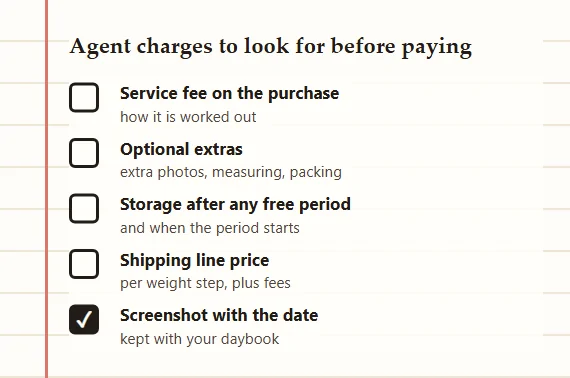
Agents earn money in a handful of ways: a service fee on purchases, fees on optional extras such as extra photos or special packing, storage charges after a free period, and a margin on shipping. Which of these CNFans uses, and at what level, was set out in a help article titled Service & Fees that we could not read in any copy.
So this site prints no fee figures for CNFans. Before you pay, find the fee lines on the checkout and the help page, take a screenshot, and copy them into your daybook with the date. That way you know what you agreed to, even if the page changes later.
The domestic hop, seller to the warehouse door
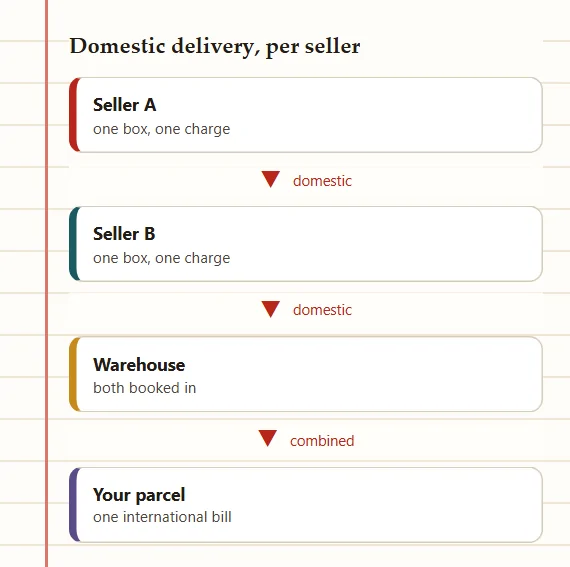
Before the international parcel there is a short domestic trip: seller to warehouse. Some sellers include it in the item price, others charge a small domestic shipping fee on top, and either way the amount is usually shown at the point you order.
It is a small sum, but it is per seller. Five items from five sellers can mean five domestic charges, while five from one seller may arrive in one box. Record it per order, even when it is nothing; a line reading “none charged” is still a record.
This is also the quiet argument for buying several things from one shop when you can. The saving is small per order, and it adds up faster than any coupon over a year of orders.
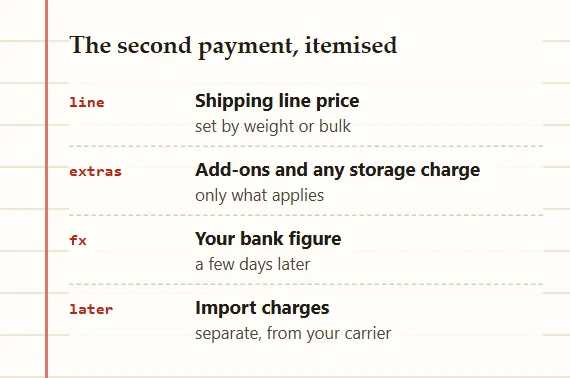
The second payment: parcel and extras
The parcel bill arrives only after the warehouse has weighed the finished box. It covers the shipping line and anything you added at that stage, such as extra packing or protective corners. If items waited past a free storage period, a storage charge may appear here too; CNFans’s own figures for that were not readable when we checked.
Write the second payment exactly as you did the first: yuan amount, your bank figure, date. Add the weight and the line name beside it, because together they explain the number better than any receipt does. Import charges, if any, come later still and belong on a line of their own.
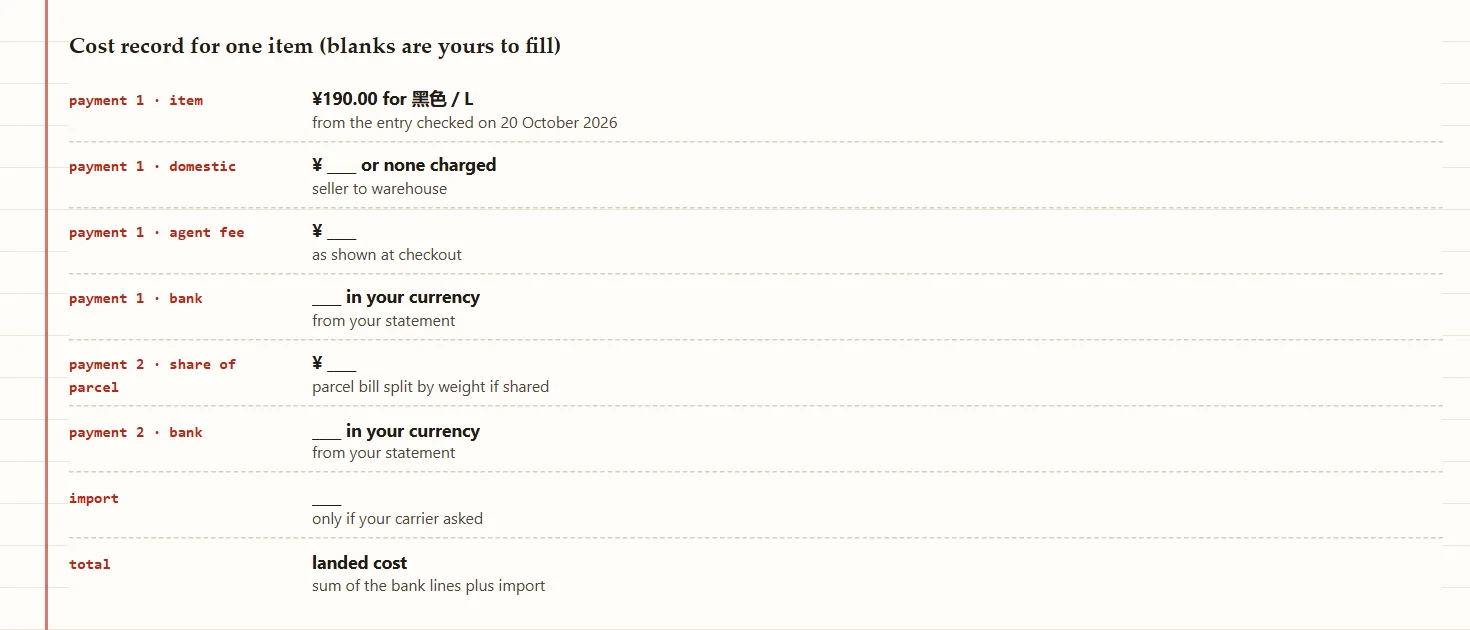
One item’s money lines, filled in as you go
Here is the cost side of an order written as a short record. The item price is from the real entry we checked; the other amounts are left as blanks to fill in from your own receipts, because any figure we put there would be a guess.
Adding the lines gives you the landed cost of the item: what it took to get it from a seller in China to your hands. Over a few orders, that number teaches you more about whether an agent suits you than any list of fees.
A worked cost entry without pretending it is a quote
These figures are an arithmetic example, not CNFans prices: an item option costs ¥180 and its seller’s domestic postage is ¥12. The first known subtotal is ¥192. A later parcel quote might show ¥150 freight and ¥8 optional packing. If those are the only confirmed charges, your known total is ¥350, before any payment conversion, service charge or destination import charge.
| Record | Example | What remains open |
|---|---|---|
| Goods + domestic post | ¥180 + ¥12 = ¥192 | Was the exact option available? |
| Parcel + chosen packing | ¥150 + ¥8 = ¥158 | Is it an estimate or the settled packed quote? |
| Known payments | ¥350 | Conversion, other selected fees, destination charges |
For several items in one parcel, keep the actual parcel bill as a parcel entry. An equal split across items is your budgeting convention, not an item-level invoice from the carrier. If an item is returned, record the refund and any unrecovered postage on separate lines rather than deleting the original payment.