Home / About the daybook
About the CNFans Spreadsheet Daybook
A guide, kept independently, to the CNFans Spreadsheet catalogue and to writing dated records of CNFans orders. Here is who is behind it, how it is paid for and how it checks what it says.
Run alone, paid by referral tags
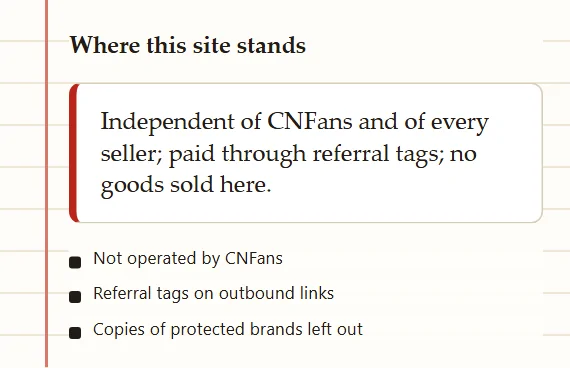
This site is run independently. It is not operated by CNFans, by the catalogue or by any seller, and nobody at those businesses reviews what we write. Links to catalogue aisles, searches and cnfans.com carry referral tags; when a visit leads somewhere, that is how the site is paid for.
The catalogue holds listings of every kind. We leave out goods sold as copies of protected brands, we do not help anyone source them, and the photos we chose for aisle cards are there to show a kind of item, not to endorse a seller or a label.
Sources, with their dates attached
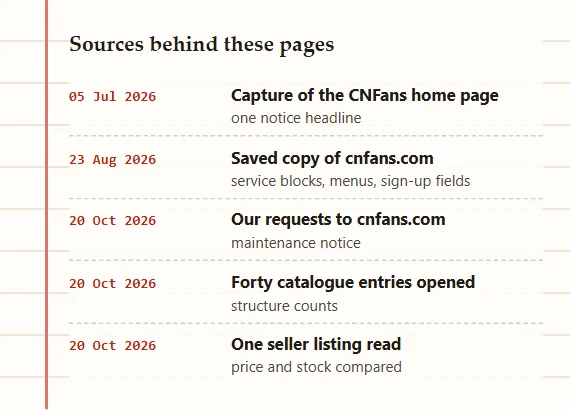
Every fact on these pages carries its date. CNFans service details come from a saved copy of its site dated 23 August 2026, one notice headline from a home-page capture dated 5 July 2026, and the current state of cnfans.com from our own requests on 20 October 2026. The catalogue figures come from entries we opened ourselves on the same day.
Where a source was missing, we say so: the CNFans articles on fees, storage, delivery, customs and returns could not be read, so no figures from them appear. Nothing here is legal, tax or customs advice; for those, the official body in your own country is the source.
Writing in, and the path a correction takes
This independent guide cannot access orders, balances or parcels. For account or order questions, use the support channel inside the agent account that holds the order. Keep the order number, the relevant photo and the date together.
Confirmed mistakes are corrected on the page and logged on the notices page with the date, so a reader who saw the old version can tell what changed.
Disagreements about judgement, as opposed to fact, get an answer rather than an edit; where a reader’s view is fairly arguable, we would rather show both than pretend there is one.
Why a daybook
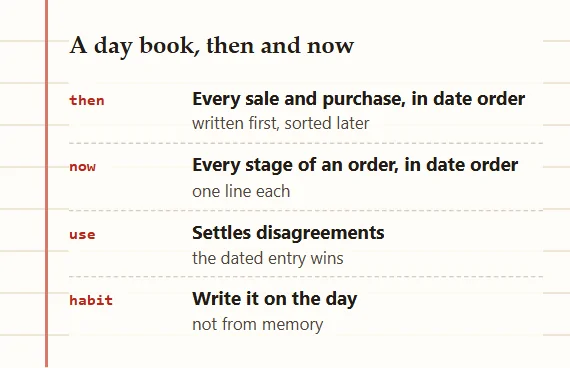
In old book-keeping, the day book was where every transaction was written first, in date order, before being sorted into accounts. It was not tidy, but it was complete, and when the accounts disagreed, the day book settled it.
An agent order is a small run of transactions spread over weeks: a choice, two payments, several hand-overs. Writing each one down on the day it happens is the habit this site is built around, and the reason each guide ends with the line worth keeping.